Claudio Fragasso is an oddly important figure in Italian filmmaking. What his films represent in his country's cinematic industry in some sense overshadow his actual role in. His film Troll 2 is a cult obssession and often viewed as the pinnacle of a crisis in Italian cinema and exemplary of the accumulated gimmicks and cost cutting procedures that had been introduced by an industry barely limping forward since the early 1980s.
Nightkiller is an odd film. I have no evidence to back it up (other than general trends in Italian exploitation cinema), but it seems like the script was intended as a psychological thriller, with certain superficial elements changed so as to capitalize on the success of the Nightmare on Elm Street franchise. It is the only way I can explain the incongruity of a realistic (at least by Fragasso standards) story of a murdering rapist and the amnesic woman he's stalking, with the fog and expressionist shadow scenes of a Freddy Krueger look-alike ramming his claws through a series of arbitrary victims (in the same manner, every time).
Literally the Same Way...
Every Time
Granted, there are scenes showing the (night?) killer taking off his mask, but much like Friday the Thirteenth Part V this is a film that wants to have its cake and it eat it too. If the killer is simply someone in a mask, how is he able to punch through people with his (apparently rubber) claws and how is he able to summon the fog? To be fair, the "fog" I'm referring to could easily be the grain and bad compression from the vhs to DVD transfer. More on that later.
I think I would have enjoyed the film more if he had simply tried to plagiarize Nightmare on Elm Street. He is much more successful with supernatural material, and his often bizarre understanding of American film comes through in even his most derivative pictures. The Fragasso penned Hell of the Living Dead is a perfect example of the this.
I don't intend to attack his filmmaking or insult Fragasso. I actually think his work is impressive in its own odd way. Troll 2 remains one of my favorite films, and one that I can watch repeatedly. He has very odd sensibilities and I think that if he spent more of his time as a director working on horror films, he might have released a few more whacked out classics. Films like Nightkiller are perhaps not as interesting because he's working with more serious material.
Another issue with the film in its current form is that the only available copy comes from a terrible vhs dub. I personally would liked to have seen a decent dvd copy of the film, or even a vhs that looks slightly less noisy and washed out. The burnt in subtitles, do not improve the experience.
The word “Epic”, in today’s young person’s vernacular, has recently taken on a slightly new meaning. It has taken its place next to that old, square “Neat”, the particularly West Coast American “Awesome”, the now dated “Fresh”, “Hype” and “Dope” and of course, the perennial “Cool”. Personally I love this newish slang status of “Epic” and enjoy using it, perhaps as a slightly sarcastic acknowledgement of my age. Making an “Epic batch of nachos” and saying a good night’s sleep was “Epic!”
Yet the word in its more classic use, has an ancient or timeless quality that comes to mind, especially when discussing the music of composer Ennio Morricone, and particularly his soundtracks to the “Spaghetti Westerns” of Sergio Leone. And “Spaghetti Westerns” don’t get any more “Epic” than Leone’s “Once Upon A Time In The West”
So, in the classic definition of Epic, what do we think of? Big and or long come to mind, and in re-viewing this film for this brief essay I will, perhaps regrettably, concur that it is long. Other words that come to mind when thinking of an epic are “myth” and “archetypes”. These are well-established concerns of the Western as a genre. Who is an archetypical cowboy? Why, Clint Eastwood of course, who made him that archetype? One could surely argue Leone. Even the phrase “Once Upon A Time…” suggests something that has always been. A legend.
George Lucas - John Williams, Tim Burton – Danny Elfman, Alfred Hitchcock – Bernard Herrmann, Federico Fellini – Nino Rota, David Lynch - Angelo Badalamenti, The Coen Brothers - Carter Burwell, etc. The history of cinema is graced (or littered) with classic, successful and /or safe pairings of director composer relationships. This is not anything startling; when people work well together why not continue on future projects? Like members of a band minus the tour van nastiness. But I offer that no other pairing in the history of cinema has been as rich as that of Leone & Morricone. That’s a hell of a thing to say, I know. But nowhere else in film, except perhaps in the Bollywood musical, does one find such an awareness and reverence of what has come before and what is “new” and an almost playful willingness to mix those two. Sure, composers and film makers have taken chances, but I’d like to offer that no one has taken chances and been as triumphant as Morricone has in the realm of what he works in, that of conventional, Western cinema (western here not referring to genre).
When one thinks of Morricone’s soundtracks to Leone’s film, generally one can call to mind the theme to “The Good Bad and The Ugly”. Recently in conversation with a colleague the question was raised if the human voice was used in soundtracks, and someone replied “not much, mostly as ethereal female soprano”. Morricone’s soundtracks are riddled with voices, and not just ethereal female sopranos, though he does use those in spades. All sorts of odd guttural male sounds, indecipherable, “native”, ceremonial chanting, wordless, hymnal melodies sung by boy choirs, etc. These almost play out as a combination of sound design as well as a memorable, though wordless, lyric. Most can mimic on cue the male voices of “The Good Bad and The Ugly”, but what are the actual words? Are they English? Italian? Native American? Are they actually words? Are they even human voices?
Morricone’s use of electric guitar is groundbreaking, it’s not rock music, and it’s not referencing “the youth problem”, and yet it has the power associated with Link Wray or Jimi Hendrix. Much like the greats of rock and roll, these guitars contain a distortion and thuggish purpose that I imagine, in the 1960’s held a degree of coolness (Or epicness) that perhaps has become, like that era’s rock, “classic”.
This appropriation and/or reference of the big, rock and roll electric guitar sound resonates as an important aspect that cannot be overlooked in postwar international art: the exchange of US 1950’s pop culture. A kind of force feeding took place after WWII, Hollywood movies, pop and rock and roll music, all consumed by the occupied territories as well as the destitute postwar axis countries reeling from the gutting effect of having its major cities bombed to smithereens, financial ruin and the general change from a rural, agricultural lifestyle to the cosmopolitan that the modern world demanded. US pop cultures almost seemed like an opiate that could sooth these changes and perhaps increase desire for more, an escape. What comes, in return, from theses countries is a sort of response. Reverent yet critical. By the time of the mid 1960’s, the US had been exposed for its “man behind the curtain” qualities with the growing Vietnam war. This coupled with the entertainment industry’s seemingly endless parade of recycled, tired ideas like the Elvis movies, one more insipid than the last allowed for a cultural hole to be filled. It’s been well established that a country like Britain took to the American Blues and Rock and Roll and turned it around to sell back to states. Similarly, I offer the French New Wave’s love for American Noir cinema was a response to their love for this particularly US post war genre. (Of note: noir directors and composers often being refugees from Europe just increased the Mobius strip of this Atlantic cultural exchange, but that’s another essay). Meanwhile, Japan with its nuclear fallout took an American classic monster movie such as King Kong and gave us back Godzilla, some suggesting that the monster IS in fact analogous to the States. And the Italians? With their penchant for machismo, and an operatic grandness and simplicity of good vs. evil, they gave us back the twisted and surreal Spaghetti Western. What was once low, pop art, through the heightened aesthetics of “Old Europe” becomes high art to the late 1960’s cinephiles.
I could not help but correlate Claudia Gorbman’s mention (in her book Unheard Melodies: Narrative Film Music) of film music’s ability to create spatial depth to Morricone’s soundtrack to “Once Upon A Time In The West”. Depth of field plays a major role in Leone’s visual compositions. He is often cited as being influenced by Japanese cinema for its sense of composition, even as far as Kurosawa’s producers successfully suing the Leone’s production company for “A Fistful of Dollars” references to Yojimbo. Although it’s hard to argue against that particular case of influence, I feel that Leone has a particularly Italian aesthetic. A quality of his depth of field can be seen in both ancient Roman architecture and in Di Cherico’s seminal work. This element is of course echoed further with Fellini’s films. A certain dreamlike/surrealistic quality established by extreme perspective and figures in space. Perhaps nowhere can one get a more surreal sense of proportion and perspective then in the American South Western desert. While Leone captures the sun cracked crevices of the actor’s face in close up, he simultaneously layers in the image of the Navajo cave dwellings and South Western plateaus and canyons made iconic by the likes of John Ford.
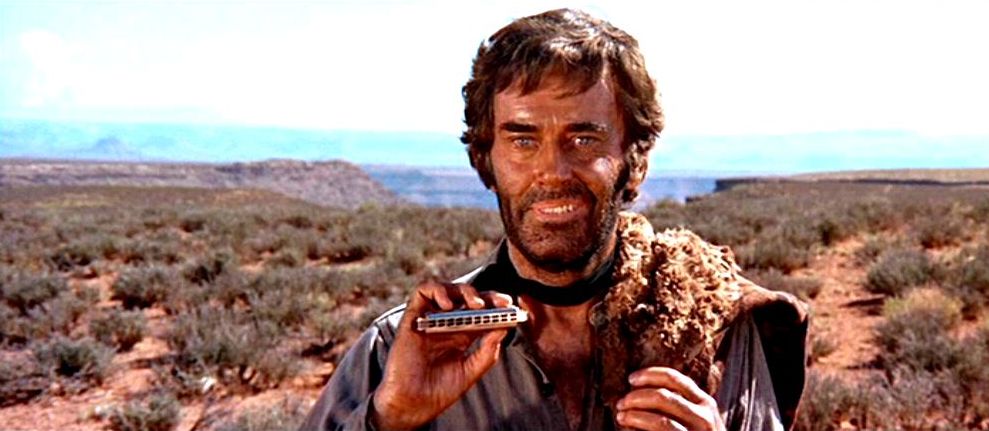
Morricone’s score resonates with this expansiveness as well as a certain claustrophobic quality. Besides adventurousness in instrumentation, Morricone seemed excited by the new development of using the recording studio as an instrument itself. In the “Man With The Harmonica” theme, for example, the harmonica itself has a processed sound, as if it was put through a tape reverb machine. This reverb not only echoes the vastness of the landscape, but also harkens to memory. The repeated loop of Charles Bronson’s Harmonica is like the gadfly in Io’s head, bouncing off the walls of his skull & driving him mad with grief and revenge.
The intentional lack of music in the opening scene also suggests newness to approach. It’s reported that various ideas of music were offered but none worked. As a result one can perhaps argue that there is a John Cage influence, which may seem annoyingly handy in the context of my interest in contemporary/20th century composers. Handy but defendable, Morricone is, of course, familiar with Cage’s theories; I doubt that any young composer in Rome in the 1960’s was not. It’s a city with a history of being open & supportive to new music, well documented on the Cramps’ Nova Musicha series. Morricone himself was part of a groundbreaking improvising collective of composers, Gruppo di Improvvisazione Nuova Consonanza. I’m not sure how much Morricone was involved in the sound design “Once Upon A Time In The West’s” opening title sequence, but I would not be surprised if Morricone was given a supervisory role in the sound design with Leone seeing the composer as such a driving force for his films, and this film in particular. So much so that Leone had Morricone compose & record the entire soundtrack to be played on set. This creative luxury is unusual and exceptional for a film composer. It was afforded by the large budget from Paramount Pictures following the success of the “Dollars Trilogy”. This on set broadcasting of the soundtrack was also no hindrance to the location sound since Italian cinema of this era NEVER used location sound. This constant ADR always added an additional surreal quality to Spaghetti Westerns to my young eyes & ears. “It’s dubbed, but these are English speaking actors?!? What’s going on here?” The lack of location sound greatly differentiates the Cageian qualities of the “natural” sounds in “Once Upon The Time In The West’s” opening versus the “true” location sound of Michelangelo Antonioni’s “The Passenger” seven years later by a fellow countrymen of the same generation.
Upon one full viewing of “Once Upon A Time In The West” we immediately get a sense of Morricone’s high regard of what Roy M. Prendergast calls in his book Film Music: A Neglected Art , the “monothematic score”: the use of one melodic theme to define a character. But here we have three main scores defining the three main protagonists; Cheyenne, Jill McBain & Harmonica. There may be one for the railroad baron and his lust for manifest destiny, but it escapes me now. Cheyenne’s is the “horse clopping”, slightly comic relief complete with banjo. Jill McBain’s is the closest we get to a traditional Hollywood score in this film, perhaps suggesting Hollywood’s “the whore with a heart of gold” character. The interesting thing about Harmonica’s theme is that it seems as if elements, primarily the electric guitar, are shared with Henry Fonda’s “against character” casting as the bad guy, Frank. This suggests that these two characters are intertwined, a ying yang (played out, of course with the iconic bad guy in black & good guy in light/white costumes).
I first saw this film home alone, as a child, flipping through the channels on a black and white TV. I stumbled upon it quite late in the film; I remember it as a “pan and scan” version before letterboxing on TV was as commonplace as it is today (adding yet another layer of surrealism coupled with the ADR). It was at the climatic, penultimate duel scene with Frank and Harmonica. My first thought was “Charles Bronson, a poor man’s Clint Eastwood” since both the Dirty Harry and Death Wish films were all the rage at the time. Though I’ve never seen either of any of those series of films, the Death Wish films always seemed seedier, cheaper. And Clint Eastwood, despite the crags always seemed conventionally handsome and American. Bronson seemed other, ethnic, and perhaps less handsome and more dangerous in the sense of conventional Hollywood language at the time. As the scene unfolds the flashback happens combining incredible music with the most brutal imagery. I had no idea what I was watching, and still am amazed by the audacity of this film and its soundtrack.
"One of the aspects that emerges in a study of this kind of cinema is a devolutionary trajectory running from a 'high' or artistically informed culture (which is de facto bourgeois) to a more vernacular cinema that 'reduces' the artistic and intellectual complexities of the antecedents into base forms of exploitation. Following from that, however, when these films are placed within a cinematic historiographic context, a different discourse opens revealing how the Nazi sexploitation cinema engages with the historical period it exploits."
- Ernest Mathijs, and Xavier Mendik. Alternative Europe: Eurotrash and Exploitation Cinema since 1945.
The above quote, for me epitomizes an interpretation of the Italian film industry I've found to be very characteristic. It has been especially helpful in explaining to those unfamiliar with Italian exploitation cinema certain incongruities of style or content. Typically I use the entire quote because it implies, when taken as a whole, the ambiguities which complicate this process of exploitation of themes. To view every excess or irregularity as the direct byproduct of consumer demand, or capitalist impulse, would be to overextend the scope of a useful model for understanding the seemingly absurd choices made in the Italian exploitation films of the 70s and 80s.
Definitions tend to be necessarily ambiguous, but I tend to view the transition from genre films to exploitation films beginning in earnest with the cannibal cycle. One of the features that I use to define exploitation is the aforementioned derivative nature of the majority of the projects. There is a sense that to be commercially successful, a film must exploit the aspects of another picture that made it commercially successful (whether or not this is actually the case).
One of the myriad reasons Nazi Sexploitation cinema is so reviled is that there is a sense, in viewing these pictures, that the directors looked at films like Salo or The Night Porter and thought to themselves "This could be improved with more exposed breasts". There is no concern that the subject itself is serious, although perhaps this reflects the displeasure of the filmmakers with their subject rather than their lack of knowledge with regard to it.
If one accepts the concept of a devolutionary track with regard to exploitation cinema the lineage of a film such as Red Nights of the Gestapo would be Salo and Salon Kitty. The film also follows a similar path to Bruno Mattei's SS Girls, with a shift in the ratio of violence to titillation (more breasts, less torture).
Both Red Nights and Mattei's film start with a conspiracy against the German reich, and a bordello constructed to ensnare those complicit. Whereas Mattei displays a certain self aware goofiness in his Charlie's Angelsesque gaggle of females, Red Night's director Fabio De Agostini (whose sole credits as a director include this film and two others, one of which contains the tagline "The Remarkable Story of a Small Boy Who Belonged to a Giant Dog!") displays his remarkable ability to retain knowledge from Pscyhe 101 by having each of the prostitutes chosen for pseudo-Freudian traits. One of the members of the "German Intelligentsia" had his mother die at a young age, naturally he gets a lactating woman. Another is a gluton; he recieves multiple women at once. There's even a disturbing bit where one of the men from the group misses his daughter, so the SS acquire a young (think six-year-old young) girl. Luckily all they do is sit on a bed for about a minute of screen time, before he gets shot by the SS.
Aside from a sub-plot about an SS officer whose wife makes puzzles of Hitler (they had those in the Germany of the 1940s?) and the discovery of a wireless microphone hidden in a cigarette lighter (once again, they had those in the Germany of the 1940s?!), that's about all that happens. The SS captain (or officer, or whatever) tries to get information out of these "German Middle Class Intelligentsia", they force them to sign a piece of blank paper, and then the SS come in and kill everyone, including the SS commander.
Cut to a freeze-frame with an arbitrary fact about the German-Russian conflict, and then "The Sleep of Reagon Creates Monsters". Yeah. The last time I saw a film with a typo that prominent was Ultra Warrior (major points if you've sat through that one).
So that's it. I didn't particularly like the film, but I wasn't as tough a sit as, say, Gestapo's Last Orgy. The phony bologna psychologist and his untreated sadists, masochists, and nymphomaniacs, are good for a couple laughs, however, on the whole most of the humor is pretty terrible (flatulence humor seems, oddly, to be a common trait of the general nazi-exploitation genre). Overall there was nothing particularly offensive about it (unless you are unsettled by the presence of Italians in Nazi regalia pretending to shag), but there's also little to recommend it. If nothing else, the film is exemplary as a generic case of Italian nazisploitation filmmaking.